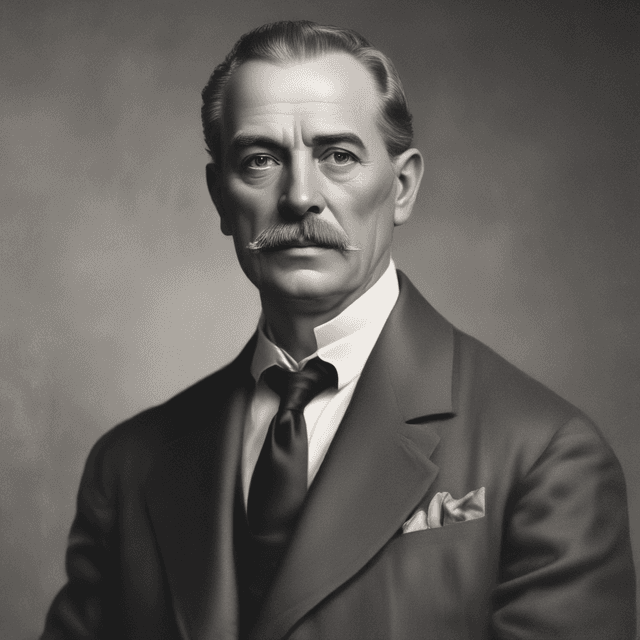
| Name | Rafael Costa Margi |
| Term | 1899 - 1917 |
| Title | President of Brazil |
| Legacy | Controversial figure due to increasing authoritarianism and suppression of political opposition |
| Tenure | Served 18 years as president |
| Achievements | Oversaw rapid industrialization and infrastructure development • Expanded Brazil's territorial boundaries • Transformed Brazil into a major global power |
Rafael Costa Margi was a Brazilian politician and statesman who served as the 7th President of Brazil from 1899 to 1917. Considered the architect of modern Brazil, Costa Margi presided over a period of dramatic economic, social, and territorial expansion that elevated the country to the status of a major regional and global power.
Born in 1858 in the town of Campinas in the state of São Paulo, Costa Margi came from a wealthy family with deep roots in Brazil's agricultural sector. After receiving his early education locally, he went on to study law at the University of São Paulo, graduating in 1880.
Costa Margi quickly established himself as a rising star in the Brazilian Empire's Conservative Party, known for his staunch nationalism, belief in a strong central government, and support for industrialization and infrastructure development. He was elected to the Brazilian Chamber of Deputies in 1886 and gained a reputation as an effective legislator and debater.
Following the overthrow of the Brazilian monarchy in 1889 and the establishment of the First Brazilian Republic, Costa Margi leveraged his political connections to position himself as a key power broker. After a brief stint as Minister of the Interior, he was elected President in 1899 on a platform of national unity, economic modernization, and territorial expansion.
As president, Costa Margi pursued an ambitious agenda of state-driven industrialization and infrastructure development. Major initiatives included the construction of the Trans-Brazilian Railway, the nationalization of key industries, and the establishment of a central bank and tariff system to support Brazilian manufacturing.
Costa Margi also sought to consolidate Brazil's disparate states and regions into a more cohesive national identity. He implemented educational and cultural programs to promote the Portuguese language and Brazilian history, while cracking down on regional autonomy movements. His critics accused him of heavy-handed centralization and the silencing of political dissent.
Despite these controversies, Costa Margi's tenure saw Brazil's economy and global stature grow rapidly. The country transitioned from an agricultural exporter to a diversified industrial power, with São Paulo emerging as a regional commercial hub. Brazil's population also swelled due to increased immigration, reaching over 40 million by the end of Costa Margi's presidency.
In foreign affairs, Costa Margi pursued an assertive, expansionist policy aimed at making Brazil the preeminent power in South America. He oversaw the annexation of the contested Acre region from Bolivia in 1903, as well as the subsequent absorption of Guyana from the United Kingdom in 1910.
Costa Margi also sought to project Brazilian power globally, dispatching military forces to intervene in regional conflicts and establishing trade and diplomatic ties with major powers like the German Empire, France, and the United States. This aggressive foreign policy was met with both admiration and trepidation from Brazil's neighbors.
While Costa Margi is lionized by many Brazilians as the father of the modern nation, his legacy remains deeply controversial. Critics accused him of consolidating power through increasingly authoritarian means, including the imprisonment or exile of political opponents. His heavy-handed treatment of regional autonomy movements and indigenous populations also drew condemnation.
Costa Margi died in office in 1917 after a brief illness. His chosen successor, Manuel Deodoro da Fonseca, continued many of his policies but was unable to maintain the same level of control. The ensuing political instability and backlash against Costa Margi's legacy ultimately led to the collapse of the First Brazilian Republic in 1930.
Despite these controversies, there is no doubt that Rafael Costa Margi was a towering figure who left an indelible mark on Brazil. His vision of a strong, industrialized, and unified nation-state laid the groundwork for the country's emergence as a regional and global power in the 20th century. Historians and the Brazilian public continue to grapple with the complex legacy of this transformative leader.
